

California follows a community property model where all assets and debts acquired during a marriage are divided equally between spouses. Separate property owned before the marriage or received through inheritance typically remains with the original owner during a divorce; however, all marital property is split fifty-fifty unless a written agreement states otherwise. There are (of course) more nuanced situations that we won't dive into here, but what's stated above is generally what happens.
Standing at the crossroads of a divorce in Los Angeles or Orange County often brings one primary question to the forefront: what happens to the life you have built together? In both counties, where marital estates frequently involve high value real estate, professional practices, and complex investment portfolios, the division of assets is rarely a simple calculation. The state’s community property laws dictate that everything acquired during the marriage belongs equally to both spouses; however, the specific application of this rule is where many individuals face significant financial risk. This guide explores the essential distinctions between community and separate property, the critical impact of your separation date, and the nuances of commingling assets.
Is California a Community Property State?
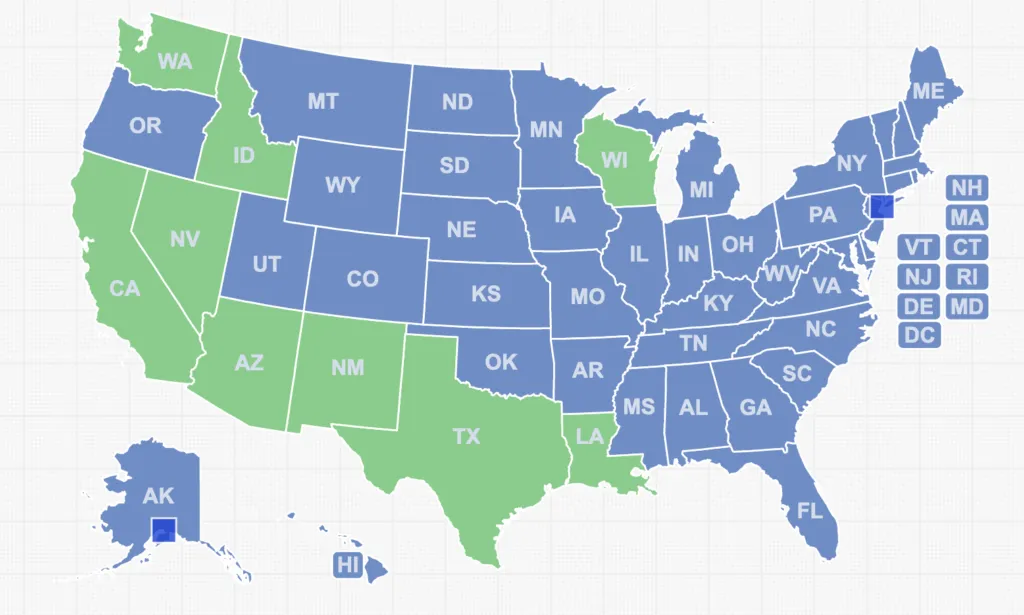
California is one of only nine states in the country that operates under community property laws. For anyone going through a community property California divorce, the governing rule is found in Family Code Section 2550. This statute mandates that the court must divide the community estate of the parties equally. Unlike "equitable distribution" states, where a judge has the discretion to divide assets based on what they deem fair or just, California law requires a strict 50/50 split of all community assets and debts.
While the concept of an equal division sounds straightforward, achieving that balance in practice is rarely simple. The community estate includes everything acquired from the date of marriage to the date of separation, but determining the exact value of those assets requires precision, cooperation, and too often, multiple trips to the courthouse to force disclosure. A 50/50 split does not necessarily mean that every physical item is cut in half; rather, it means the net value of the estate must be equalized between the spouses.
The calculations involved in complex dissolutions can become incredibly intricate, especially when dealing with professional practices, real estate portfolios, or retirement accounts. Determining what constitutes the community versus what remains separate is the first hurdle in the process. Because the financial stakes are high, navigating these rules requires more than just a basic understanding of the law. Working with a Certified Family Law Specialist ensures that the characterization and valuation of your assets are handled with the expertise required to protect your financial interests during a transition. Particularly true in extreme high net worth cases, we will engage third-party experts to assist in valuations and effectuating an equal division. This ensures a few things: first, you and your spouse know you're getting an equitable outcome (even if one or both of you don't like it); and second, it protects the judgment from being challenged later.
Defining Community Property vs Separate Property in California
The process of dividing assets begins with characterization. This is the legal term for identifying which items belong to the marital partnership and which belong exclusively to one individual. Before a judge or mediator can facilitate a 50/50 split, every bank account, piece of furniture, and debt must be sorted into one of two categories.
Community Property: The presumption is that any asset or debt acquired by either spouse between the date of marriage and the date of separation belongs to both parties equally. This includes: Income and wages earned by either spouse during the marriage; Real estate and personal property purchased with those earnings; Debts, such as credit card balances or mortgages, incurred during the marriage, regardless of whose name is on the account.
The physical location of the property does not matter; if it was acquired during the marriage while the couple resided in California, it is generally community property.
Separate Property: Remains the sole possession of one spouse and is not subject to the 50/50 division rule. Under California Family Code 770, separate property includes: Anything owned by a spouse prior to the marriage; Assets acquired after the date of separation; Inheritances or gifts received by one spouse, even if they were received during the marriage; Rents, issues, or profits derived from separate property.
For those filing for divorce in California, characterization is often the most litigated phase of the case. It is important to understand that how an asset is titled does not always determine its character. For example, a vehicle purchased during the marriage is still community property even if only one spouse's name appears on the registration. Correctly identifying these distinctions is the first step toward a fair resolution in Orange and Los Angeles County courts.
The Significance of the Date of Separation
The "date of separation" is another aspect that can be highly litigated during divorce. Under California law, this date marks the official end of the community estate. It is defined as the point when there is a complete and final break in the marital relationship, demonstrated by one spouse communicating their intent to end the marriage and performing actions consistent with that intent (moving out works best, but there can be other acts that demonstrate their desire to end things).
This date serves as a financial cutoff. Any income earned or debts incurred by either spouse after this moment are characterized as separate property rather than community property. For example, if a spouse receives a significant year-end bonus shortly after the separation date, that bonus may still be community property. Conversely, if one party incurs massive credit card debt post-separation, the other spouse is generally not liable for half of that liability.
Because significant sums of money often hang in the balance, parties frequently disagree on when the separation actually occurred. Proving this date requires objective evidence beyond just a verbal argument. Courts look for specific behaviors, such as moving into a different residence, opening independent bank accounts, or filing for divorce. In complex dissolutions, establishing an accurate date of separation is the essential foundation for an equitable financial split.
When Separate Property Becomes Community: Commingling and Transmutation
While the definitions of separate and community property seem rigid, the reality of a long marriage often blurs these lines through commingling and transmutation. Commingling occurs when separate property funds are mixed with community assets to the point that they can no longer be easily distinguished. A common example involves a spouse receiving an inheritance and depositing those funds into a joint savings account used for monthly family expenses. Over years of various deposits and withdrawals, the separate character of that inheritance may be lost to the community.
Transmutation is the formal process of changing the character of an asset from separate to community, or community to separate. Under Family Code Section 852, a transmutation is only valid if it is made in writing by an express declaration (meaning, you should use a variation of the word "transmute") that is joined in, consented to, or accepted by the spouse whose interest in the property is adversely affected. This frequently occurs when one spouse transfers the title of a premarital home into both spouses' names during the marriage.
The danger in these situations is that without a clear, documented tracing of funds, a judge may rule that the separate property has been swallowed by the community estate. Tracing requires a meticulous forensic accounting of where money originated and how it was spent since the date of acquisition or until filing for divorce in California. The ability to prove the separate origin of an asset is vital. Protecting your separate property requires a strategy rooted in evidentiary precision, even when attempting to resolve disputes through mediation.
Special Rules for Complex Assets: Retirement Accounts, Businesses, and Homes

Navigating your divorce requires an understanding that many high-value assets are not purely community or separate, but rather "mixed" character. When an asset contains both components, California courts apply specific formulas to apportion the value accurately. This is not a matter of simple math; it requires a deep dive into financial records and the application of established case law.
Retirement accounts, such as 401ks and pensions, are primary examples of mixed assets. If a spouse began contributing to a plan years before the wedding, the pre-marital balance and its subsequent growth remain separate property. However, all contributions made between the date of marriage and the date of separation, along with the proportional growth on those funds, are community property. Calculating these interests often involves a "time rule" formula. Furthermore, the final division requires a Qualified Domestic Relations Order (QDRO) to ensure the funds are moved without triggering premature withdrawal penalties or immediate tax liabilities.
The family home often presents the most significant challenge in divorce. If one spouse owned a residence prior to the marriage but used marital earnings to pay down the mortgage, the community acquires a pro-tanto interest in the property. Courts use a "Moore-Marsden" calculation to determine the exact dollar amount the community is entitled to, named for the case law establishing the math. This calculation accounts for the capital appreciation of the home and the reduction of the loan principal during the years the couple lived together.
Closely held businesses and professional practices also require sophisticated analysis. If a business was started before the marriage but grew significantly during the union, the community may be entitled to a portion of that increased value. Depending on whether the growth was driven primarily by market forces or by the personal efforts and talent of the spouse, courts apply either a "Pereira" or "Van Camp" analysis to determine the community’s share. Because these assets are subject to market fluctuations and technical legal formulas, professional valuation is indispensable. Engaging a Certified Family Law Specialist ensures that forensic accountants and appraisers are properly utilized to secure a precise financial outcome before finalizing your divorce in Los Angeles or Orange County.
What is Quasi Community Property?
For many residents who have recently relocated to Orange County or Los Angeles County, property acquired before moving to California presents a unique legal question. This is where the concept of quasi-community property becomes essential in a community property California divorce. Defined under Family Code Section 125, quasi-community property includes any real or personal property acquired by either spouse while living in another state that would have been classified as community property if the couple had lived in California at the time.
This rule is particularly relevant for those coming from equitable distribution states. For instance, if you purchased a vacation home or built a retirement account while living in a non-community property state, California courts will treat those assets as if they were community property once you become a resident of California. This ensures that the 50/50 division rule applies to the entire marital estate, preventing a spouse from losing their interest in assets simply because of a change in residency. In complex dissolutions, correctly identifying these assets is a critical step in achieving a precise net value equalization.
Division of Community Debts and Liabilities

Getting divorced is not solely a search for assets; it is a meticulous accounting of the net value of the marital estate, which often includes a significant amount of debt. Under the law, liabilities incurred between the date of marriage and the date of separation are divided equally, just like bank accounts or real estate. This includes mortgages, auto loans, tax liabilities, and credit card balances. A common misconception among those filing for divorce in California is that a debt belongs only to the person whose name is on the account or loan document. In reality, if the obligation was incurred during the marriage, both spouses are generally equally responsible for its satisfaction, regardless of which spouse signed the application. Here again, I want to mention the "general" nature of our discussion, as there can be nuanced factual scenarios which could be argued to change the equal responsibility rule for apportioning debts.
There are other notable exceptions to this 50/50 rule, most significantly regarding student loans. Generally, educational loans are assigned to the spouse who received the education. The law presumes the degree or professional training remains a separate benefit to that individual after the marriage ends. However, if the community substantially benefited from the education, often analyzed by the length of time since the degree was earned (typically 10-years), or if the loans were used for general family living expenses, the court may re-evaluate this assignment.
To ensure all liabilities are accurately captured, the law requires a thorough exchange of Preliminary Declarations of Disclosure (PDOD). These documents are essential in complex dissolutions to identify hidden or overlooked debts that could skew the net value equalization. Transparency regarding liabilities is critical to ensure the final judgment reflects a true 50/50 split of the marital bottom line, preventing one spouse from being unfairly burdened with community debt.
Common Questions About Property Division in California
Navigating your unique situation often raises very specific questions regarding the limits of the 50/50 rule. Understanding these nuances is essential for protecting your financial future during the legal process.
What assets cannot be split in a divorce?
Assets classified as separate property are exempt from the equal division mandate. This includes any property owned prior to the marriage, gifts given specifically to one spouse, and inheritances. Additionally, personal injury awards are often treated uniquely. While damages for an injury occurring during the marriage are technically community property, California law generally requires that these specific funds be awarded to the injured spouse upon dissolution, provided the funds were not commingled. These are often referred to as community property personal injury damages, yet they are typically assigned to the individual who suffered the injury.
If my wife inherits a house, am I entitled to half?
Generally, no. Under California law, an inheritance is the separate property of the receiving spouse, regardless of whether it was received before or during the marriage. You do not automatically gain an interest in a home your spouse inherits. However, the community may develop a claim if marital earnings were used to pay down a mortgage on that home or to fund significant capital improvements. If the spouse formally changes the title to include both names, a transmutation may have occurred, changing the character of the asset. Identifying these specific contributions is vital to ensure a fair division.
Can a spouse cut the other off financially during separation?
Once a party begins filing for divorce in California, Automatic Temporary Restraining Orders (ATROs) go into effect immediately. These orders, found on the back of the Summons, prohibit both spouses from transferring, hiding, or disposing of any property, community or separate, without a court order or written agreement. ATROs are meant to preserve the estate and maintain the financial status quo. If one spouse attempts to drain joint bank accounts or cancel health insurance policies, the court can issue sanctions. Reach out to Salmons Family Law for assistance in establishing a temporary support agreement that respects these legal boundaries while the case proceeds.